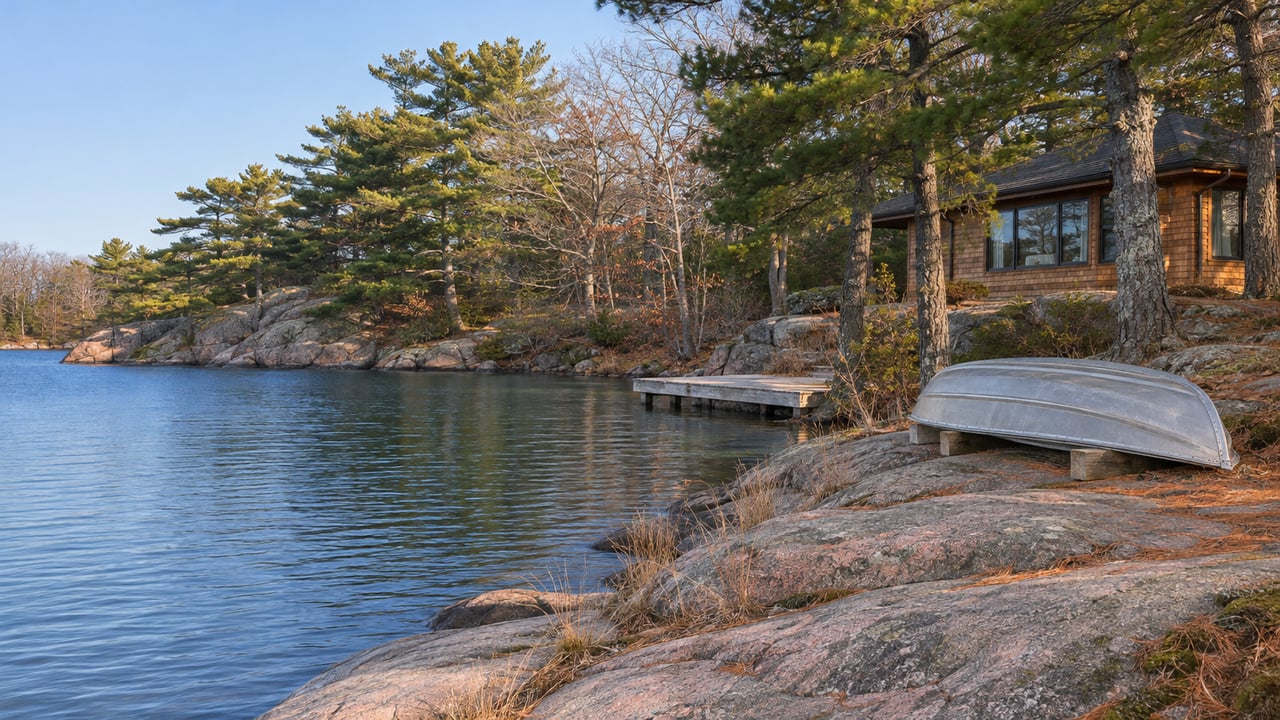
The Honey Harbour Boat Club's water taxi has finished its usual season. The club says the taxi typically runs from May through the end of October, weather permitting. It charges by distance, does freight runs at an hourly rate, and doesn't run after dark. The club's winter hours are now Monday to Friday, 8 a.m. to 5 p.m., closed Saturday and Sunday. For an island cottage across the channel, the next planned visit by anyone is probably a single boat patrol in late November or early December. After that, visits depend on the ice.
That calendar matters to anyone comparing an island cottage with a mainland one in Honey Harbour. An island cottage gets checked a few times over the winter, and each check depends on the ice. A cottage on a mainland lane can be checked on a fixed schedule as often as every 72 hours. The listing doesn't show this difference, but you live with it for half of every year you own the place.
Three planned visits, set by the ice
For island owners, the main off-season check comes from the community. The Honey Harbour Association runs a Cottage Patrol for members. Its stated goal is to inspect each member's cottage three times over the winter, ice conditions depending. The targets are a patrol by water in late November or early December, then by snowmobile in late January and again in March. Members get photos of their property at each visit. If the patroller finds open or broken doors or windows, fallen trees, heavy snowfall or a break-in, members get a further report on that.
The association is clear about how this works. The inspector decides when and how each inspection happens, by boat or snowmobile, and safety comes first. Patrols start in November and the association tries to complete as many as it can, depending on ice safety. Some may be cancelled because of weather or poor ice. Actual dates go out in the association's winter newsletters, not on a calendar posted ahead of time.
The cost is modest. On the association's current pricing page, full membership is $195 for one year and lists "Cottage Inspection: Fall, Winter (if ice is safe), & Spring" among its benefits. The patrol covers the main cottage. Each extra building on the same lot that sits more than 15 metres from the main cottage, such as a sleeping cabin or tool shed, costs another $30, for up to three extra buildings.
At that price, this is good value, run by cottagers for cottagers. It still has limits. Over one winter, it is a set of photos taken when the ice allows. The gaps between visits come at the times the ice is hardest to predict.
Why the gaps fall where they do
The patrol's planned timing follows the ice. A late-November or early-December boat run is the last chance before freeze-up. The January and March snowmobile runs fall in the part of winter when the ice can carry a machine. Between them come the stretches when neither a boat nor a snowmobile can safely reach the island.
The Georgian Bay Association warns that early winter and late spring are especially dangerous, because ice can be unstable and its thickness and quality can change quickly and vary from place to place. In March 2025, Southern Georgian Bay OPP warned that above-zero temperatures and rain could make the ice unsuitable for foot or machine travel, as MidlandToday reported. A December storm that drops a tree on the roof, or a March thaw that floods a crawlspace, can happen in one of those unreachable stretches. The cottage may sit as it is until the next safe crossing.
On a mainland lane, the calendar sets the schedule
A cottage on a mainland lane a short drive from the Boat Club is in a different position. Home Resetters, a Barrie-based property-services company, updated its Severn and Honey Harbour cottage-care page on October 19, 2026. That page lists watch checks around Honey Harbour and Port Severn at four intervals. As of that update, prices per visit are $69 for a check every 72 hours, $79 weekly, $89 every two weeks and $99 monthly. The same page lists monthly memberships at $149 and $269, and flat-rate openings or closings at $249 each. The company puts Honey Harbour about 66 minutes from its Barrie base and sends a photo report after every visit.
The company is direct about islands. It visits by road only, so it handles island and boat-access cottages "case by case rather than a standing schedule." Every check interval applies on the mainland lanes around Honey Harbour and Port Severn.
The start of November to the end of April is 181 days. A check every three days over that stretch comes to about 60 visits. At $69 each, the October 2026 per-visit price, that is roughly $4,140 for the season. The Cottage Patrol plans three visits for a $195 membership. A mainland lane can be watched on whatever schedule the owner chooses to pay for. On an island, the ice limits how often anyone can get there, however much the owner is willing to spend.
The boat is on land too
Mainland services are still open to island owners for the boat itself. The 2025 Canadian Sailing Directions list the Honey Harbour Boat Club marina and Nautilus Marina as open all year. That refers to the marinas, though, and the Boat Club gives its own taxi season as May through October. Bluewater Lodge and Marina has winter haul-out, winterization, and indoor heated, outdoor covered and outdoor shrink-wrapped storage. In Port Severn, South Bay Cove's annual dockage package pairs May-to-October dockage with spring launch, fall haul-out and outside dryland storage from November to April.
For an owner whose boat is in winter storage on the mainland, with the water taxi done for the season, the picture is simple. Unless the owner has made a private arrangement, the association patrol is the planned way anyone looks at the island over the winter. Car parking at the Boat Club is $11.85 a day plus tax, with seasonal discounts available by inquiry, according to the club's taxi and parking page updated in March 2026. Its $8.76 daily trailer charge applies on top of that. These costs belong in your planning for when you'll actually visit the island in the shoulder months.
What this changes in an island-versus-mainland comparison
Our earlier look at mainland versus island cottages in Honey Harbour set out the summer trade-offs. The winter side is narrower, but it is something you can measure. Think about how many times between November and April someone will actually see the building, and who that will be.
For a mainland-lane cottage, that number is up to you, and each visit has a set price. For an island cottage, it is about three planned visits, adjusted for the ice and carried out by the association's patrol. Buyers who will be in Toronto most of the winter should weigh that difference alongside frontage, exposure and privacy, and choose an island with that rhythm in mind.
Because the patrol sends photos at each visit, an island cottage can come with a record of its past winters. When you are seriously considering one, ask the seller whether they were an association member. If they were, ask whether they will share past Cottage Patrol photos and reports, which outbuildings were covered, and whether anything was flagged in a given winter and how it was dealt with. You can also ask whether the owner used any private arrangement for winter access. A seller may or may not have kept these records. Either way, the answers tell you more about how the cottage has come through its winters than a summer showing can.
If you are looking at listings in the off-season, our piece on buying a cottage in the winter covers the general approach. In Honey Harbour, one more question applies to island cottages: how the place gets watched over the winter, and by whom.
A few questions buyers ask
Can an island owner join the Cottage Patrol after buying? Full membership is open to anyone who owns property or vacations in the Honey Harbour area. It runs for one year, and the inspection is listed as a membership benefit. Sign-up is through the association's member account.
Does the patrol check every building on the lot? The main cottage is inspected and photographed. Sleeping cabins, tool sheds and other buildings more than 15 metres from it can be added for $30 each, up to three.
When will this winter's patrols happen? The targets are late November or early December by water, then late January and March by snowmobile. Actual dates go out in the association's winter newsletters, and the inspector makes the final decision based on safety.
If you own an island or water-access cottage in Honey Harbour and are thinking about selling, your winter record is part of what buyers will be weighing. At Coxworth & Associates, our work centers on water-access and island transactions, and a marketing plan for your cottage is a good place to talk through the patrol reports, marina arrangements and access details buyers will ask about. Request a Complimentary Valuation & Marketing Plan, and we'll start with how your cottage comes through the winter.